The first computer I used was a 286 running DOS. I was a child, and getting anything out of it meant learning its language: directory paths, command switches, the exact spelling of everything, because the machine made no allowances for you. By the time I got to college to study IT, the labs were full of Windows 95. Same subject, same me, and a completely different relationship with the computer. I didn't recognise it as a transition at the time. Looking back, I lived through the moment computing stopped requiring you to learn its terms and started translating them into yours.
That translation was the whole of what the GUI did. Files, folders, a desktop, a recycle bin: none of these exist inside the machine. They're metaphors, chosen so people could carry what they already knew about offices and paperwork into something unfamiliar. It worked so well we stopped noticing it was there. Computing went from a specialist activity to something an entire workforce did all day, and the people who had been gatekeepers of the command line had to find a new role.
But the GUI never removed the translation burden, it only reduced it. Every application still requires you to learn its terms: where the settings are kept, what the icons mean, which sequence of menus produces the thing you actually want. Anyone who has watched a capable colleague hunt through the ribbons of an unfamiliar tool knows the interface is a skill in itself. For forty years the arrangement has been interface first, intent second. Learn the tool, then express what you want through it.
AI reverses that arrangement. You state the intent in natural language and the system does the interface work.
I see this most clearly in a personal project. I run a home automation and personal assistant setup, and over the past year I've built chatbots into it. When I want a file processed, I drop it into the conversation and it gets handled there, with no logging into a web app and no upload form. When I want to know something that lives in a database, I ask the question and get the answer in plain English. Most organisations still run the old version of that second task: log into a portal, find the right dashboard, set the filters, search, scan the table, extract the number. The data hasn't changed and neither has the question. What's changed is who does the interface work, which has moved from me to the system, and what comes back. The old route gets the number out of the machine; the new one gets the number and the context that makes it useful, and most of the value is in that context.
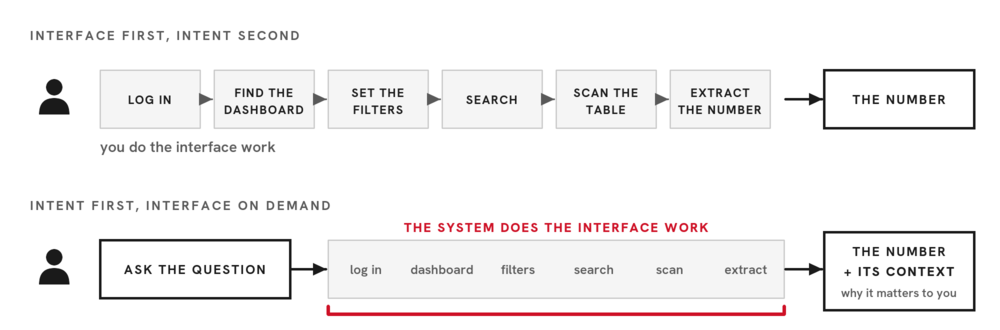 Figure 1. Same data, same question. Interface first, you do every step and get the number; intent first, the system does the steps and you get the number with the context that makes it useful to you.
Scale that up and you get what people have started calling the anything app: one conversational surface through which everything else is reachable. The apps don't disappear. They stop being things you open and become capabilities the AI calls on your behalf.
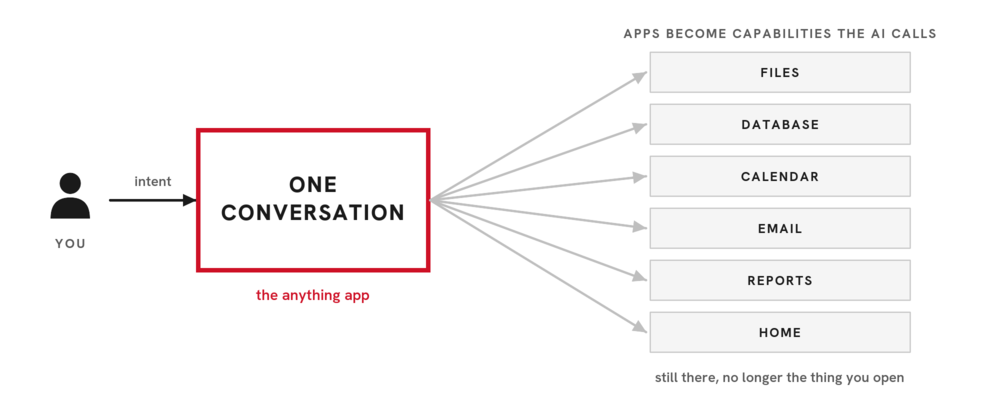 Figure 2. The anything app. One conversation in front; the apps are still there, called on your behalf rather than opened.
The obvious question is whether that kills the GUI, and I think the last transition already answered it. The CLI never died; it got repositioned. It stopped being the way most people reached the computer and became the professional's tool, which it still is today. Developers, engineers, anyone automating things at scale works in a terminal, because for precision and repeatability nothing beats it. What the GUI took from the CLI wasn't its existence but its position as the default.
The same repositioning is coming for the GUI, because conversation is genuinely bad at three things visual interfaces are genuinely good at.
The first is discoverability. A conversation starts empty. It doesn't show you what's possible, what's adjacent, or what you didn't know to ask for. A well-designed interface shows you what a system can do before you've formed a question.
The second is precision. Some intents are faster to show than to say: picking a shade of blue, dragging a boundary on a map, nudging a column until the layout looks right. Describing any of these in words is slower and worse than doing them directly.
The third is verification, and it matters more in this transition, not less. A table, a chart, a diff, a preview: these let you check work at a glance in a way prose can't. The thing doing the work on my behalf can now be confidently wrong, so the more intent I hand over, the more I want a fast visual way of confirming what it actually did.
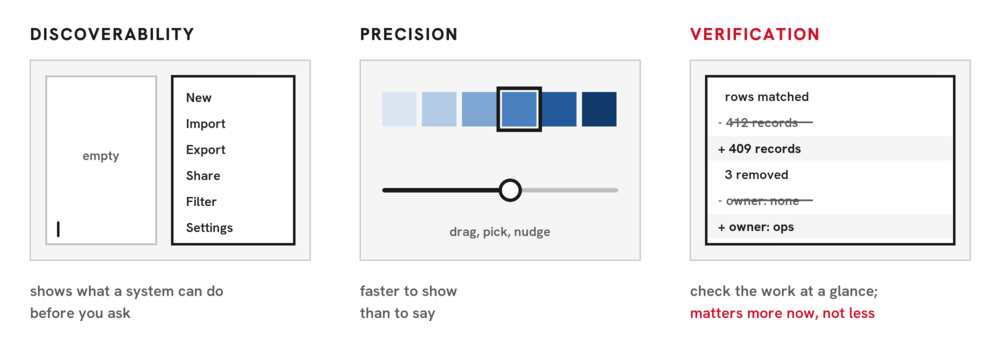 Figure 3. What conversation is bad at and the GUI keeps: showing what is possible, direct manipulation, and checking the work at a glance.
Each of these shifts lowers the bar to entry, and I think that is where the value goes. The GUI changed little about what a computer could do and a great deal about who could use one. Computers existed long before Windows; the desktop is what put one in front of most of the workforce, and the money followed those new users rather than any new capability in the machine.
I expect conversation to lower the bar again, and further, because the barriers it removes are ones a graphical interface mostly left in place. You can ask in your own language rather than the one the software was written in. If you can't use a keyboard or mouse, you can speak. If you can't speak, you can type. If you can't see a screen, you can listen. Where you are may come to matter less as well. You still need a device and a connection, but the people the interface itself has kept out are the ones this shift is most likely to let in.
So the conclusion I've reached is repositioning, not replacement. Conversation takes over intent. The GUI stops being the thing you open and becomes something produced on demand, generated for the task in hand rather than designed once for everyone. In March, Dave Chismon, the NCSC's CTO for Architecture, made a related argument about vibe coding in Vibe check: AI may replace SaaS (but not for a while): "the cost/effort curve for ‘bespoke enough’ software is shifting", with the caveat that the transition "will take years rather than months". If bespoke enough software is getting cheaper, bespoke interfaces are getting cheaper too, and an interface you can generate when you need one doesn't have to be the permanent front of anything.
If the interface can be produced on demand, the interface is no longer where the value sits. That is uncomfortable for large organisations, and having spent my career around government systems I'd include those. Value moves down the stack, to the quality of the data underneath and to how well a system can be operated by something other than a human clicking through screens. Decades of buying and building have optimised for the opposite: polished front ends over well-modelled data, and systems that assume a person is navigating them. The organisations that get the most out of this shift won't be the ones that add the best chat window to the front. They'll be the ones whose data is good enough, and whose systems are open enough, to be driven by intent.
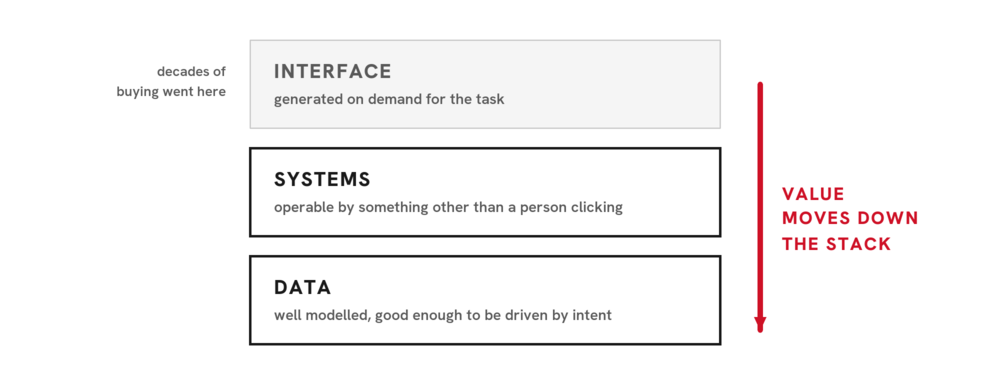 Figure 4. Value moves down the stack: from the interface, where decades of buying went, to systems that can be operated by intent and the data under them.
The layer that does the driving is the subject of The intent layer: an AI layer now sits between the person and the systems, choosing which ones get touched, and in the organisations I work with nobody owns it yet. The two pieces go together. That one is about who owns the layer; this one is about where the value moves once the interface it produces is generated on demand.
Sources
- Dave Chismon, Vibe check: AI may replace SaaS (but not for a while), Inside the NCSC blog, 24 March 2026 (the two quoted lines: the cost/effort curve for "bespoke enough" software shifting, and the transition taking years rather than months). The post says nothing about interfaces; the sentence that follows the quotes is my inference.
- The home example, the DOS and Windows 95 history, and the argument are my own.