The advantages an organisation is surest of are the ones AI erodes first. What it knows, how expert its people are and how well it runs all feel permanent from the inside, and that is what makes them dangerous: they can be losing their value for a long time before anyone inside notices.
BCG has put this on a chart. In "Who Will Win as AI Rewrites Competitive Advantage?", Jesper Nielsen and colleagues map the usual sources of advantage on two axes, "the depth of the protective moat and its durability under AI". Top right, deep and durable, are physical assets, flow data, network scale and trusted relationships. Bottom right is what it calls "the most precarious quadrant": "advantages that were previously deep enough to feel permanent but are now fragile: knowledge and expertise, stock data, and operational excellence". These are, in its words, "most likely to look intact from the inside while eroding from the outside". Its name for that is "hollowing": revenue, market share and customers all still there while the margin and the pricing power disappear.
BCG doesn't say which organisations sit in that bottom-right quadrant, so I will, starting with my own profession. A consultancy sells knowledge and expertise, and operational excellence is the other half of the pitch: we know how to run the programme as well as what should be in it. A government department is built on the same three things: expertise in its policy area, people who have run the service for years, and the operational knowledge of how it works in practice. The same is true of any organisation whose value lies in what its people know, whether that is a law firm, an engineering practice or a utility's asset management team.
BCG comes close to naming consultancies in one line:
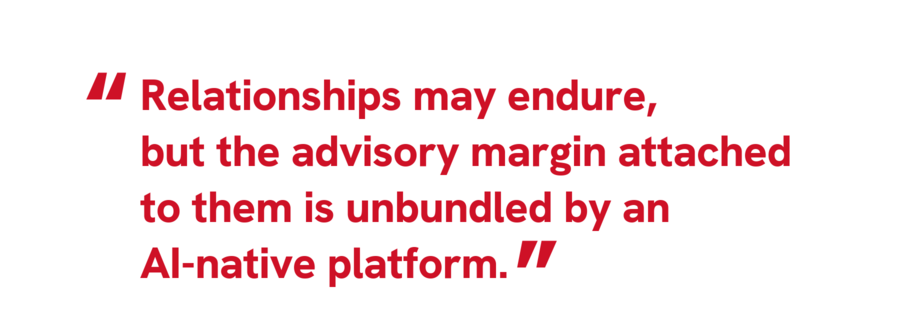
What makes hollowing hard to see is that the work carries on. The reports still get written, the programmes still get run, the clients still renew. What changes is what the analysis is worth once a model can produce most of it, and BCG's comparison is with a company built from the start around AI economics, with none of an incumbent's headcount, offices or inherited ways of working, and a cost base for knowledge work far below it. What gets competed away is the margin on the analysis, and the relationship it was delivered through survives.
Trusted relationships are in the quadrant that keeps its value, and BCG's reason is the one that matters to anyone selling expertise: they "become more valuable as AI commoditizes the analysis delivered through them". Flow data is in it too, data continuously generated by the work and fed back into it, which "compounds in a way that stock data cannot". A library of past reports and a methodology are stock. The live record of what was tried on a programme and what happened next is flow, and in my experience few of us treat it as an asset.
In The Anything App I argued that value moves down the stack, to the data underneath the interface. BCG's version is that durable advantage "migrates downward, to the assets and structures beneath the technology".
BCG's advice is to audit each advantage and ask whether AI is leaving it "strengthened, eroded, or hollowed". Done honestly for a consultancy, most of what we sell comes out as hollowed, and the answer isn't to defend it. It's to charge for the part that is getting more valuable, the trust a client puts in our judgement once the analysis is cheap, and to turn the stock of what we know into a flow: the data from doing the work, captured as we go, rather than the document written about it afterwards. For a department the same audit points the same way: the expertise sits in people's heads and leaves when they do, and the operational data from running the service is the part that compounds.
Sources
- BCG, Who Will Win as AI Rewrites Competitive Advantage?, by Jesper Nielsen, Rahul Khubchandani, James Tucker, Ketil Gjerstad, Gerry Hansell and Hans Roedahl (every quoted line, and the quadrant placements, which are taken from the article's text about Exhibit 4, "AI Is Redrawing the Map of Competitive Advantage"). Read from a saved copy of the page, because BCG's site refuses our reader. The saved page shows no publication date.
- The link from BCG's bottom-right quadrant to consultancies and government departments is my own. The article says nothing about consultancies, government or the public sector. The closing view on what to do about it is mine.
- The Anything App, my own note (value moves down the stack).